
If you’re not already aware of my story, I’ll start with a little overview. I have been living in Germany for about two years. In order to study at a German university, or a Hochschule in my case, I had to complete a series of prerequisites to be accepted. Germany is quite selective when it comes to allowing foreigners to study in their country, making it a difficult journey. While their school system is indeed excellent, the application process can be quite tedious.
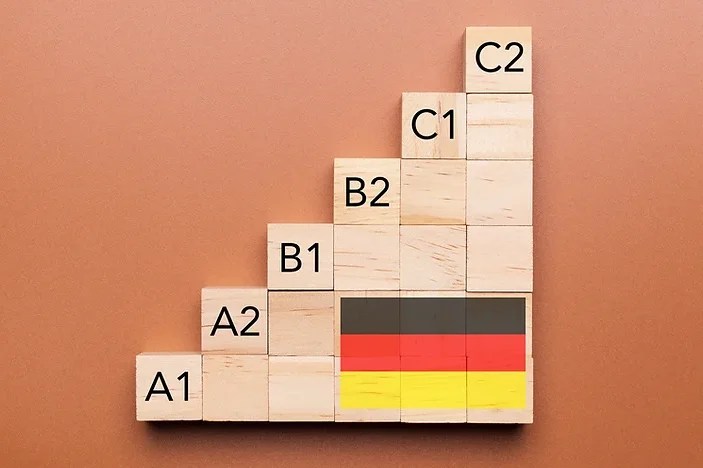
To illustrate how arduous the process can be, here’s a (now) funny story from when I tried to apply to the University of Mannheim for a Business degree, a well known school for business in Germany. For most degrees at this university, you are required to show proof of your English skills at the C1 level. (Languages are ranked from A1, the bare minimum knowledge, to C2, complete fluency.)
Since I was born and raised in the US and went through the American school system, I assumed this would be sufficient proof of my English proficiency. However, this was not the case. The university insisted I take a C1 English language test to ensure I could indeed speak fluent English. Needless to say, after discovering this requirement and realizing there was no way around it, I decided to apply elsewhere.
This is just an example of how exacting they are in following their guidelines. They adhere strictly to their set procedures, and this meticulousness extends to many other aspects and processes in Germany.
However, my attempted application to the University of Mannheim came after completing the prerequisites for studying in Germany. So, what did these prerequisites include? Primarily, they involved learning the German language and attending a Studienkolleg. Naturally, if I’m wanting to study in German, I need to understand the language. But what exactly is a Studienkolleg?
Studienkolleg in short
A Studienkolleg is an institution designed to prepare international students for studying at a German university. If your school-leaving certificate, such as a high school diploma, is not recognized as equivalent to the German Abitur (the qualification needed for university admission), you might need to attend a Studienkolleg.
Studienkolleg is similar to your senior year of high school, but conducted entirely in German. It spans two semesters and focuses on intensive German language instruction as well as subject-specific preparation necessary for your intended university degree.
Types of Studienkolleg Courses
There are 5 different types of courses (or in German, “Kurse”) offered at different Studienkollegs around germany. Each are tailored to specific fields of study. Here’s an overview of the different courses possible to take:
- T-Kurs (Technik)
- Focus: Mathematics, physics, chemistry, and other sciences.
- M-Kurs (Medizin)
- Focus: Biology, chemistry, physics, and mathematics.
- W-Kurs (Wirtschaft)
- Focus: Economics, business administration, and social sciences.
- G-Kurs (Geisteswissenschaften)
- Focus: Humanities subjects such as history, German, literature, and social studies.
- S-Kurs (Sprachwissenschaften)
- Focus: Languages and linguistics.
Admission and Requirements
You first need to be accepted into a Studienkolleg, which is another lengthy process. There are two main requirements for this:
Language Proficiency: You need a certain level of German proficiency, usually B2, to enroll. To achieve this, I spent my first seven months in Germany attending language schools. Progressing from A1 to B2 took time, but I had a lot of cool experiences along the way.
Entrance Exam: You must also pass an in-person entrance examination (Aufnahmeprüfung) that each Studienkolleg constructs themselves. The tests vary depending on the intended study direction or “Kurs.” Since I wanted to take the W-Kurs, I had to pass both a German and a math test.
Not the only way to study in Germany
While attending a Studienkolleg is one of the most recognized pathways for international students to gain acceptance to a German university, it is not the only route available. There are alternative methods to qualify for higher education in Germany.
If you have already completed at least one year of study at a university in your home country (one that meets German standards), you can apply directly to a German university with the addition of a C1 language test.
Since I hadn’t begun my studies in the US, I opted for the Studienkolleg route.
My experience with Studienkolleg
I attended the Studienkolleg Mittelhessen at the Philipps-Universität Marburg from September 11, 2023, to June 12, 2024.
I wasn’t entirely sure what to expect, but even though we were studying on a university campus, it often felt like I was back in high school. Classes ran from 8:00 am to 3:30 pm most days, so I had to readjust to the rhythm of a full school day.
On a side note, one cultural nuance worth knowing, especially for Americans studying in Germany, is the distinction in terminology for the word “school.” In the US, the term encompasses all levels of education, from elementary school to university. In Germany, saying “I have school tomorrow” (Ich habe morgen Schule) refers to attending gradeschool, so from elementary to high school. For higher education, you need to specify by saying “Ich habe morgen Uni” (I have university tomorrow). I occasionally still mix this up, and people will jokingly respond with, “You’re still in school?!”
My classmates came from a diverse array of countries, including Ukraine, Brazil, Russia, Vietnam, China, Georgia, Mongolia, Uzbekistan, and, of course, the United States. With such varied backgrounds, our German language skills differed, despite the required B2 fluency for acceptance. This often made English a common language of communication, a trend also evident in the language schools I attended. With English being my native language, I made an effort to speak German as much as possible. Groups naturally formed based on shared country of origin or language spoken. Most of my classmated were proficient in three languages and some even more! Being the only American, I often found myself moving between different friend groups, and got to experience a wide range of cultures and perspectives.
The schoolwork at the Studienkolleg was quite engaging. One of the major benefits of attending a Studienkolleg before starting university is that you learn all the specific terminology related to your chosen degree in advance, which is incredibly helpful. Everyday German and academic German are quite different. Trying to grasp the meaning of terms while simultaneously understanding their relevance in University would be extremely challenging without this preparation.
I gained valuable insights during my time in W-Kurs, which was solely focused on business-related subjects. It helped me recognize that pursuing a degree in this field was definitely the right choice for me. Some of my classmates had already realized in the first semester that they weren’t actually interested in business, prompting them to switch to different courses in subsequent semesters. So, it’s also beneficial in this aspect—you get to test out a subject before fully committing to it at university.
Some advice I would offer to future international students considering a similar path is to actively seek friendships outside of Studienkolleg as well. While all of my classmates were wonderful and enjoyable company, experiencing the culture involves forming connections with local Germans. Engaging with native speakers not only enhances language skills but also provides deeper insights into daily life, customs, and traditions. For example, living with Germans in a shared apartment, joining a sports club, or participating in Uni-Sport are all excellent ways to do so. With five German roommates, it’s never been boring!
In summary, Studienkolleg has been a dynamic experience of academic challenges, cultural discoveries, and new friendships. It prepared me for university while introducing me to a diverse global community of students. Looking back, I value the growth and insights gained during this pivotal phase, broadening my perspective on global education and life abroad.

 Around the World with Abigail
Leave a Reply!